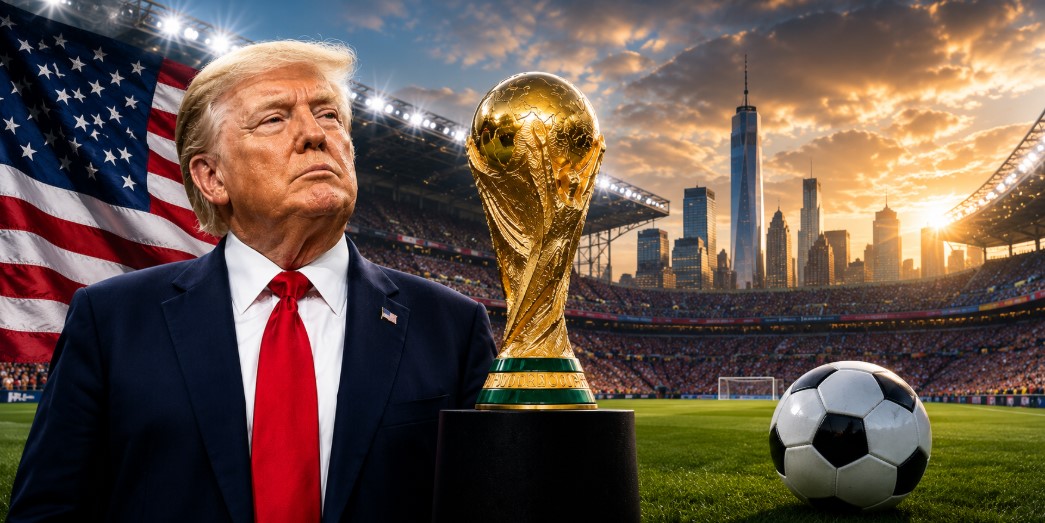
The 2026 FIFA World Cup concluded with a dramatic mix of championship soccer, politics and a global spotlight on the United States.
Spain captured the World Cup championship Sunday, July 19, defeating defending champion Argentina 1–0 in the final at New York New Jersey Stadium in East Rutherford, New Jersey.
But as the trophy ceremony began, attention briefly shifted from the players to President Donald Trump.
Trump walked onto the field alongside FIFA President Gianni Infantino to participate in the post-match ceremony and was greeted by audible boos from sections of the crowd. Reuters reported that boos descended from the stands as Trump and Infantino entered the field, though the reaction subsided as medals were presented.
The moment provided a politically charged ending to a tournament that had already placed Trump, immigration policy, international relations and America’s global image alongside the soccer itself.
The Washington Post reported that Trump had loomed over the tournament politically and was loudly booed as he entered the field following Spain’s victory. His prominent role in the trophy ceremony further blurred the traditional boundary between international sports and domestic politics.
More Than a Soccer Tournament
The larger story, however, is what the World Cup meant for the United States.
The expanded 48-team tournament brought millions of spectators into stadiums across the United States, Canada and Mexico, with American cities carrying the largest share of matches.
For one month, cities including New York/New Jersey, Los Angeles, Miami, Dallas, Houston, Philadelphia, Atlanta, Kansas City, Seattle, Boston and the San Francisco Bay Area became international gathering points.
Hotels, restaurants, bars, transportation systems and entertainment districts all benefited from World Cup traffic—although the economic results were not uniform.
Early projections were enormous. A FIFA/WTO-backed economic study estimated that the World Cup and related soccer activity could contribute $17.2 billion to U.S. GDP, $30.5 billion in gross economic output and support approximately 185,000 full-time-equivalent jobs. Those numbers are projections and should not be confused with final audited economic results.
There is already evidence that some host markets experienced significant spending increases. The Wall Street Journal reported strong business activity in several host cities, with some restaurants and bars experiencing extraordinary World Cup crowds and Bank of America reporting a 6.3% increase in credit- and debit-card spending in June, although economists cautioned that the tournament’s complete national economic impact will take time to calculate.
That distinction matters.
Mega-events frequently generate impressive headline projections, but economists debate how much spending represents genuinely new economic activity versus money that would have been spent elsewhere. Some businesses and cities benefited substantially, while other tourism expectations did not always materialize as predicted.
America’s Soccer Culture Changed
The tournament’s biggest legacy may extend beyond dollars.
For decades, critics questioned whether soccer could ever occupy the same cultural space in America as the NFL, NBA or Major League Baseball.
World Cup 2026 demonstrated something different.
American stadiums became stages for supporters from Argentina, Spain, Brazil, Mexico, England, Morocco and dozens of other nations. Watch parties filled public spaces. Bars adjusted schedules around matches. Soccer became a daily national conversation.
The United States also advanced from the Round of 32 before its run ended against Belgium in the Round of 16, giving American fans a home-team storyline deep enough into the tournament to sustain domestic interest.
The next question is whether that momentum carries into youth soccer, Major League Soccer, international club competitions, television audiences and the 2028 Los Angeles Olympics.
Trump’s Boos Tell Another Story
Trump’s reception also demonstrated something unique about international sporting events.
A World Cup crowd is not a political rally.
It is an enormous cross-section of Americans, international visitors and supporters from dozens of countries.
The boos cannot scientifically measure national public opinion, and it would be inaccurate to claim the entire stadium rejected Trump. But the audible reaction was significant because it occurred on one of the largest global stages ever hosted in the United States.
It also created a striking contrast.
On the field, Spain celebrated becoming world champion.
In the stands, tens of thousands of people represented cultures and countries from around the world.
And on the podium stood an American president whose policies and political style remain deeply polarizing.
That collision of sports, politics, economics and culture may ultimately define how America remembers the 2026 World Cup.
The tournament was never just about soccer.
For more than a month, the world came to America—and America showed the world who it is.