
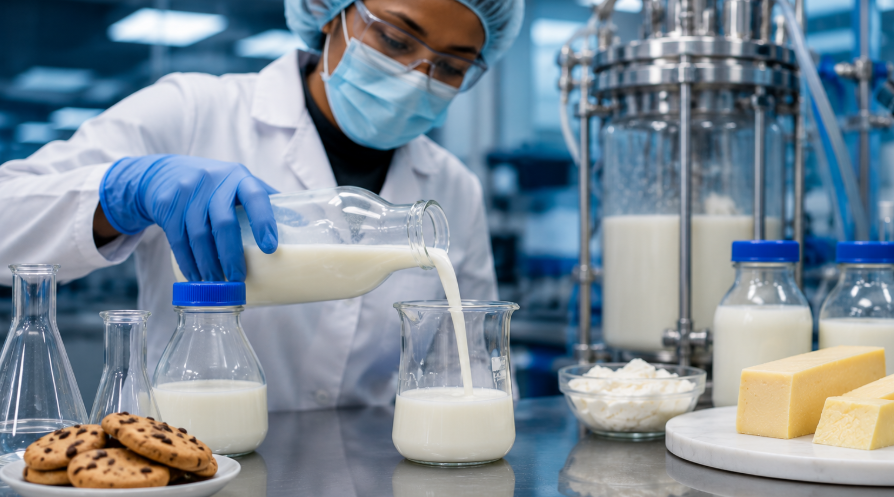
For decades, the dairy aisle has looked much the same. Whole milk, skim milk, cheese, butter, yogurt, and ice cream have all come from one source: cows.
That could soon change.
Boston startup Brown Foods has developed UnReal Milk, a lab-grown whole milk created using mammalian cell culture rather than traditional dairy farming. If the company’s plans move forward, the product could begin reaching consumers through a pilot launch in 2026.
Unlike almond, soy, or oat milk, UnReal Milk isn’t designed to imitate dairy. The goal is to produce the same milk proteins, fats, and carbohydrates found in conventional cow’s milk—without the cow.
How Does It Work?
Scientists begin with mammary cells capable of producing milk. Those cells are cultivated in carefully controlled bioreactors, where they generate the essential components of dairy. The resulting ingredients are then combined to create milk that is intended to closely match traditional whole milk at the molecular level.
Brown Foods says the technology could eventually be used to produce not only milk but also cheese, butter, yogurt, and ice cream.
If successful, it would represent one of the most significant advances in food technology in decades.
The Environmental Argument
Supporters believe cultivated dairy has the potential to dramatically reduce agriculture’s environmental footprint.
Brown Foods says its production process could use:
- Approximately 90% less water
- Around 95% less land
- Roughly 82% fewer carbon emissions
If those figures prove achievable at commercial scale, cultivated dairy could become an attractive option for countries facing water shortages, climate challenges, and growing food demand.
Questions Still Need Answers
As promising as the technology sounds, several important questions remain.
Can the product be produced at a price consumers are willing to pay?
Will people feel comfortable drinking milk made in a laboratory?
How will the FDA regulate and label these products?
Will traditional dairy farmers see cultivated dairy as innovation—or competition?
Public perception may ultimately determine whether this technology succeeds or struggles.
Plant-Based vs. Lab-Grown
Many consumers already purchase oat, almond, soy, or coconut milk. Those beverages are made from plants and are intended to serve as dairy alternatives.
Lab-grown milk is fundamentally different.
Instead of replacing dairy with plant ingredients, scientists aim to produce genuine dairy components through cellular agriculture. The objective is to deliver the same taste, texture, and nutritional profile associated with conventional milk while reducing reliance on livestock.
That distinction could become an important part of how these products are marketed.
A New Era for Food?
Every generation witnesses technologies that initially seem unusual before becoming commonplace.
Microwave ovens, genetically modified crops, plant-based meat substitutes, and electric vehicles all faced skepticism before gaining broader acceptance.
Lab-grown dairy could follow a similar path—or consumers may decide that traditional milk remains the preferred choice.
Either way, the conversation has already begun.
As food science continues to evolve, shoppers may soon have more choices than ever before when deciding what to pour over cereal, add to coffee, or drink with dinner.
One thing is certain: the future of dairy may look very different from its past.
What Do You Think?
Would you drink milk made without cows if it tasted the same and offered comparable nutrition?
Share your thoughts in the comments.
– Diamond K
The Diamond K Show | OnFire Broadcasting