Twenty-five years after the September 11 terrorist attacks, America remembers the 2,977 people who were killed, the heroes who ran toward danger, and the consequences of a morning that changed the country forever.
September 11, 2001 began as an ordinary Tuesday morning.
People went to work. Parents dropped their children off. Travelers boarded airplanes. Employees made their way into offices at the World Trade Center and the Pentagon.
Within less than two hours, the United States — and ultimately much of the world — would be changed forever.
Today, September 11, 2026, marks 25 years since the deadliest terrorist attack in American history.
For millions of Americans, 9/11 remains a personal memory. They remember exactly where they were when they heard the news. They remember watching the television as smoke poured from the World Trade Center. They remember the confusion surrounding the first impact — and the horrifying realization after the second.
But 25 years later, an entire generation has grown up knowing September 11 only as history.
That makes telling the complete story more important than ever.
8:46 A.M.
At 8:46 a.m., American Airlines Flight 11 crashed into the North Tower of the World Trade Center in New York City.
Initially, there was confusion. Was it an accident? Had something gone terribly wrong aboard an aircraft?
Then, at approximately 9:03 a.m., United Airlines Flight 175 crashed into the South Tower.
Millions watched the second impact on live television.
There was no longer any question.
America was under attack.
The two aircraft were among four commercial planes hijacked that morning by 19 members of al-Qaeda.
The Attack Reaches Washington
At 9:37 a.m., American Airlines Flight 77 crashed into the Pentagon in Arlington, Virginia.
The headquarters of the United States Department of Defense was burning as the crisis continued to unfold in New York.
In Manhattan, firefighters, police officers, paramedics and other emergency personnel rushed toward the World Trade Center while thousands of people desperately attempted to escape.
At 9:59 a.m., the South Tower collapsed.
Less than 30 minutes later, at 10:28 a.m., the North Tower fell.
The towers that had dominated the Lower Manhattan skyline were gone.
The streets surrounding the World Trade Center became engulfed in smoke, dust, debris and ash. Images of people running through Manhattan and first responders disappearing into the destruction became some of the defining pictures of the day.
Flight 93: They Fought Back
There was still another hijacked aircraft in the sky.
United Airlines Flight 93 was traveling toward Washington when passengers and crew members began learning through telephone calls that other hijacked airplanes had already struck the World Trade Center.
They understood what was happening.
And they decided to fight back.
Passengers attempted to retake control of the aircraft from the hijackers.
At 10:03 a.m., Flight 93 crashed into a field near Shanksville, Pennsylvania.
All 40 passengers and crew members were killed.
Their actions are believed to have prevented the hijackers from reaching their intended target in Washington.
Their final moments became one of the most powerful stories of courage to emerge from September 11.
2,977 Lives
By the time the attacks were over, 2,977 victims had been killed, excluding the 19 hijackers.
There were 2,753 victims in New York, 184 at the Pentagon and aboard Flight 77, and 40 passengers and crew members aboard Flight 93.
The victims represented approximately 90 countries.
But numbers alone cannot adequately explain September 11.
These were mothers and fathers.
Sons and daughters.
Husbands and wives.
Friends and coworkers.
Firefighters, police officers, military personnel, airline employees and ordinary people who woke up that morning expecting to return home.
Thousands of families instead received phone calls that changed their lives forever.
The Heroes Who Ran Toward Danger
One of the enduring lessons of September 11 is what ordinary people are capable of doing under extraordinary circumstances.
While thousands were trying to escape the World Trade Center, firefighters and other first responders were climbing the stairs toward the fire.
They knew the danger.
They went anyway.
Hundreds of first responders were killed that day.
But the human cost of September 11 did not end when the fires were extinguished.
Rescue and recovery workers spent weeks and months at Ground Zero, often working in an environment filled with toxic dust and contaminants. Survivors, residents and workers throughout Lower Manhattan were also exposed.
In the decades since, thousands have been diagnosed with cancers, respiratory illnesses and other conditions associated with exposure to the disaster site.
Twenty-five years later, people are still dying because of September 11.
That continuing health crisis is now inseparable from the story of 9/11.
America Changed
September 11 did more than destroy buildings and take thousands of lives.
It changed the direction of the United States.
Less than a month later, American forces entered Afghanistan as the United States pursued al-Qaeda and the Taliban government that had provided the terrorist organization sanctuary.
The war in Afghanistan would eventually become America’s longest war.
The United States later invaded Iraq in 2003, although Iraq was not responsible for the September 11 attacks.
At home, security changed dramatically.
Airport screening became far more intensive. The Transportation Security Administration was created. The Department of Homeland Security was established. Intelligence agencies were reorganized, and the USA PATRIOT Act expanded government surveillance and investigative powers.
Americans began debating questions that remain relevant today:
How much privacy should citizens surrender in exchange for security?
How should the United States respond to terrorism?
When should America use military force?
And what happens when a temporary response to an emergency becomes permanent government policy?
September 11 also produced another painful consequence.
Muslim, Arab, Sikh and South Asian Americans faced harassment, discrimination and violence as fear and anger spread throughout the country.
Remembering 9/11 requires remembering those consequences as well.
25 Years Later
Today, America marks a quarter century since the attacks.
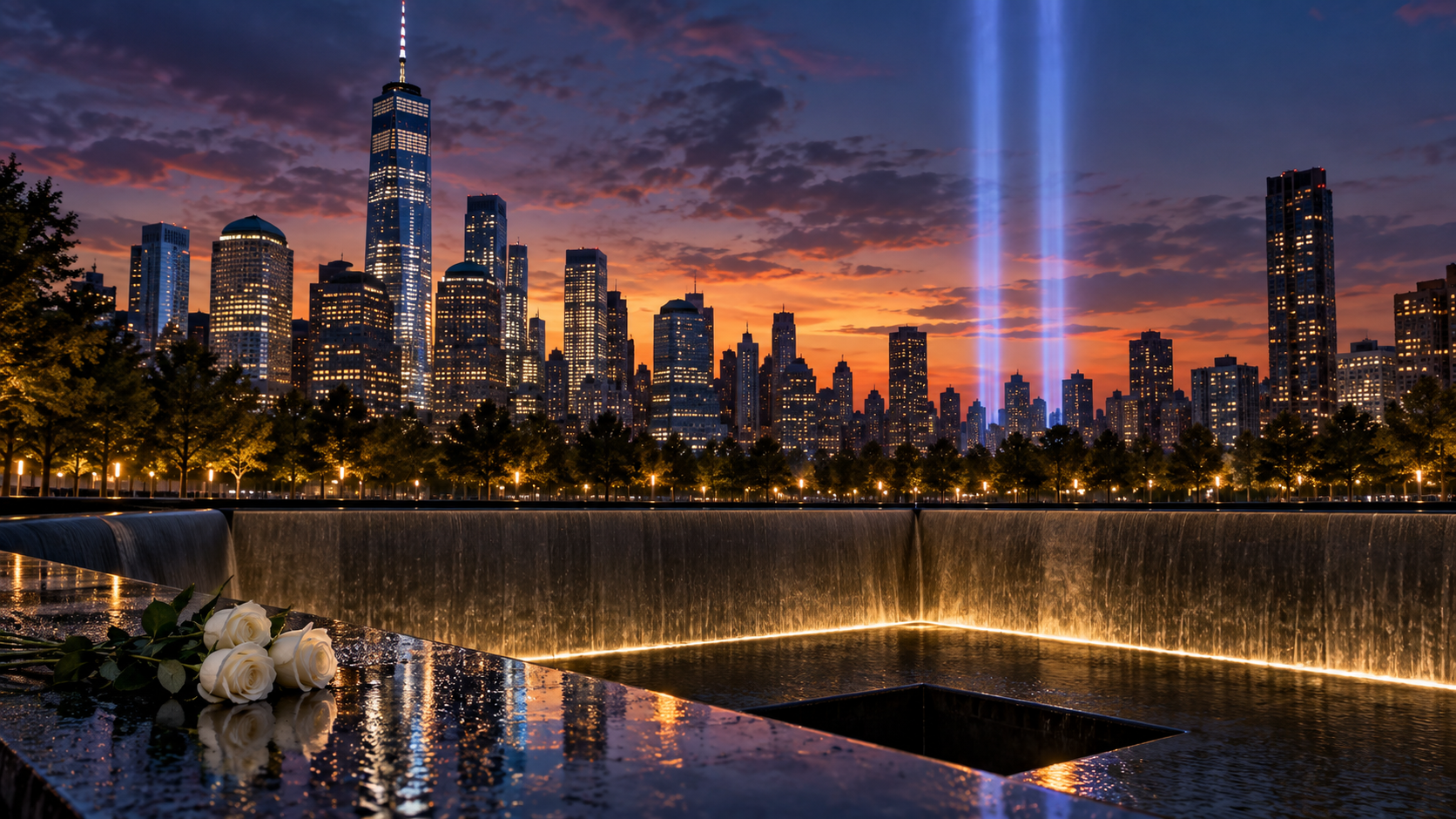
Families have again gathered at the National September 11 Memorial in Lower Manhattan, the Pentagon and the Flight 93 National Memorial in Pennsylvania.
Names are being read.
Bells are being rung.
Moments of silence are being observed.
The familiar words remain:
Never Forget.
But those words carry a different responsibility in 2026 than they did in the years immediately following the attacks.
A generation of Americans has now reached adulthood with no personal memory of September 11.
They didn’t watch the second airplane strike the South Tower.
They didn’t see the towers collapse live.
They don’t remember airports before TSA checkpoints.
They don’t remember the fear and uncertainty of the days immediately following the attacks.
To them, September 11 is something that happened before they were born.
It is history.
What Does “Never Forget” Mean Now?
This may be the most important question as America observes the 25th anniversary.
“Never Forget” cannot simply mean remembering images of airplanes and collapsing buildings.
We must remember the people.
We must remember the passengers aboard Flight 93 who decided to fight back.
We must remember the firefighters climbing stairwells while civilians were coming down.
We must remember the police officers, paramedics, military personnel and ordinary citizens who helped strangers.
We must remember the families who lost people they loved.
We must remember the first responders and survivors who became sick years later.
And we should remember the decisions America made afterward — including both the decisions that made the country safer and those that remain subjects of legitimate debate.
Because September 11 is not merely the story of one horrific morning.
It is a story about fear, courage, sacrifice, grief, war, government power, national unity and the consequences of decisions made during moments of crisis.
Twenty-five years later, we are still living in a world shaped by what happened that morning.
For those of us old enough to remember September 11, perhaps our responsibility has changed.
For years, we said:
Never Forget.
Now we must add something else.
Never stop telling the story.
Because eventually there will be no one alive who remembers watching September 11, 2001 unfold in real time.
History survives only when one generation makes the decision to pass it to the next.
Today we remember the 2,977 lives taken on September 11, 2001, the people who risked everything trying to save others, and those whose lives were permanently changed by what happened.
Twenty-five years later, their stories still matter.
And they always will.
— Diamond K Report | OnFireLive