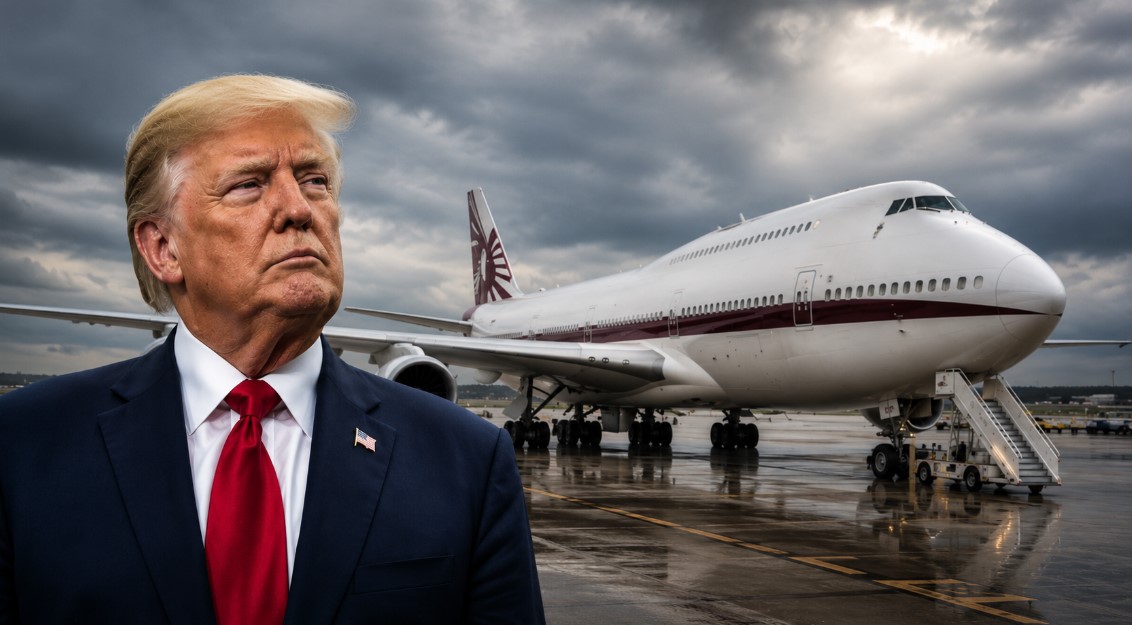
President Donald Trump’s newly introduced presidential aircraft is headed back out of service—at least temporarily.
The Boeing 747-8 donated by Qatar and converted for presidential use will undergo another round of upgrades, with Trump saying the aircraft will be “maxed out.” The president is expected to return to using the older Air Force One during the work.
The development comes only weeks after Trump took his first presidential flight aboard the aircraft on July 1.
The jet has been valued at approximately $400 million and was donated by Qatar in an unusual government-to-government arrangement. Its acceptance generated controversy from the beginning, including questions involving ethics, national security and the ultimate cost of converting a luxury civilian aircraft into a plane capable of safely transporting the president.
The Security Question
Air Force One is much more than a luxury aircraft.
Aircraft used for presidential transportation require specialized secure communications, defensive capabilities and other classified systems designed to protect the president and maintain command capabilities during emergencies.
The exact defensive configuration of the Qatar-donated aircraft is classified. However, recent reporting has raised questions about whether the expedited conversion provided the full range of capabilities associated with the existing presidential fleet.
Trump said the aircraft would undergo additional work and be “maxed out,” with the process expected to take roughly a month.
Why Was the Jet Needed?
The Qatar aircraft was intended as an interim solution while the United States waits for Boeing to complete two purpose-built replacement presidential aircraft.
Those aircraft have faced significant delays, leaving the administration searching for a faster alternative. The Qatar-donated Boeing 747-8 offered an existing aircraft that could be modified more quickly—but the speed of that conversion has itself become part of the controversy.
The Bigger Political Question
The latest development does not necessarily mean the aircraft was unsafe to fly. The White House has maintained that the aircraft was safe for presidential travel.
But taking such a high-profile aircraft offline shortly after its introduction for further security enhancements will inevitably renew scrutiny of the decision-making process.
The central questions now are straightforward:
How much will the additional work cost taxpayers? What capabilities were omitted or deferred during the initial expedited conversion? And why was the aircraft placed into presidential service before these additional upgrades were completed?
Those questions matter because Air Force One is not simply transportation—it is effectively a flying command center for the president of the United States.