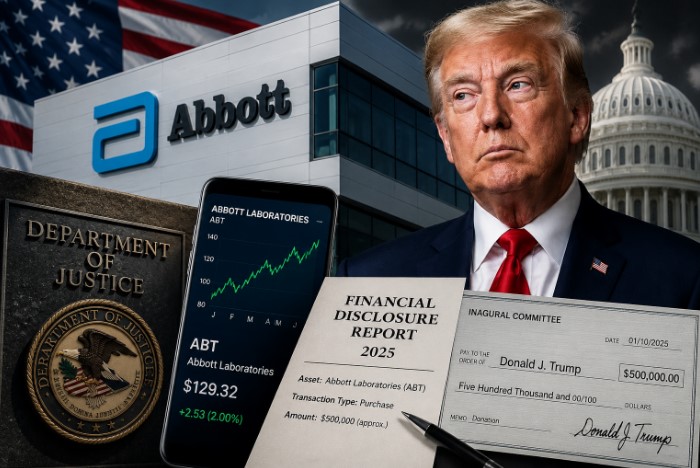
A renewed debate over ethics and corporate accountability has emerged following disclosures involving Abbott Laboratories and President Donald Trump.
According to Trump’s annual financial disclosure, the president purchased approximately $500,000 worth of Abbott Laboratories stock during 2025. Around the same time, Abbott had previously contributed $500,000 to Trump’s inaugural committee.
The controversy intensified after the U.S. Department of Justice closed its years-long criminal investigation into Abbott over conditions at the company’s Michigan infant formula plant. Federal prosecutors had reportedly considered criminal charges related to the facility before senior DOJ officials ultimately opted to resolve the matter through civil enforcement instead.
The investigation stemmed from the 2022 infant formula crisis, when Abbott shut down its Sturgis, Michigan plant following the discovery of Cronobacter bacteria. The closure contributed to a nationwide baby formula shortage. While several infant illnesses were investigated, Abbott has consistently maintained that no unopened formula sold to consumers tested positive for the bacteria that sickened the infants and has denied that its products caused those illnesses.
Critics, including former Labor Secretary Robert Reich, argue that the donation, Trump’s stock purchase, and the DOJ’s decision create the appearance of a conflict of interest.
Supporters of the administration counter that no evidence has been presented showing the president directed the Justice Department’s decision or personally benefited from the DOJ ending the investigation. The department has said criminal prosecution would have been “heavy-handed” and that civil remedies were more appropriate.
At this time, there is no public evidence establishing that Abbott’s political donation or Trump’s stock ownership caused the DOJ to end its criminal investigation. However, ethics experts say the sequence of events is likely to continue drawing political scrutiny.